
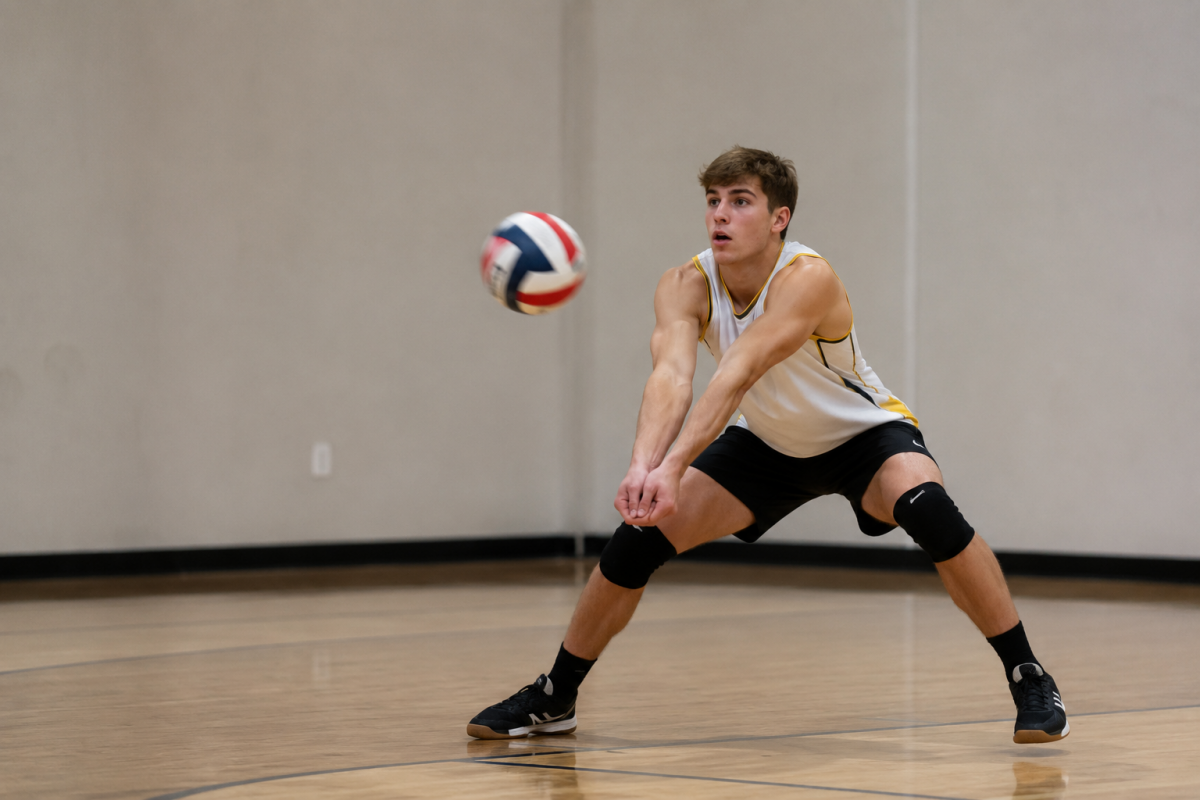

Every boy who plays volleyball is familiar with “the pause”.
While chatting at a lunch table, in a classroom, or with a relative at Thanksgiving, the subject of sports comes up, and he is asked what sport he plays.
“I play volleyball.”
Then comes the pause, while the other person tries to figure out how to react to this surprising revelation. The young man is already prepped for the next question, “Isn’t that a girls’ sport?”
In most of the country, and certainly here in Tennessee, a boy who plays volleyball is playing something the culture has quietly filed under someone else. He has learned to sit in that pause without flinching. Most boys his age cannot.
Often, that composure gets read as a consolation. ‘Poor kid, couldn’t make the real teams, so he found the leftover sport.’ It is a lazy read, and it is exactly backwards, because the status quo usually sees innovation as odd or foreign.
Early Adopters Get the Best Options
Here in Tennessee, boys volleyball isn’t a sanctioned high school sport (yet). Our state offers it to girls and, for now, files the boys under “not a thing.” So on paper, a Tennessee boy who plays volleyball is choosing a sport that officially does not exist for him. That is about as far out of the mainstream as an athlete can get. But innovation is what changes the mainstream, and it’s happening quickly.
Boys volleyball is currently the fastest-growing high school sport in the country. Participation is up about 40 percent since 2017, and last year alone it jumped almost 13 percent, to nearly 96,000 boys. Colleges have added more than 80 new men’s programs in five years. In North Carolina, boys volleyball went from 7 schools to 135 in four years. Tennessee is now working through the process to sanction it, with a real target inside the next few seasons.
Read that again. The boy everyone at the lunch table thinks is behind is standing at the front of a line that is about to get very long.
A tall, athletic 13-year-old is one of a million on a football field. On a volleyball court he is one of a far smaller pool, in a sport that is adding college teams faster than it can fill them.
That is not a soft observation. It is a strategic one. While a million American boys grind through the most crowded funnels in youth sports, fighting for the same football roster spots and the same basketball minutes that were spoken for before they hit puberty, this boy quietly picked the lane with room to run and a wave building behind it. A tall, athletic 13-year-old is one of a million on a football field. On a volleyball court he is one of a far smaller pool, in a sport that is adding college teams faster than it can fill them.
I certainly don’t want to oversell it. Men’s volleyball is not a scholarship printing press, and none of this is a shortcut. But if you are a family thinking clearly about where an athletic boy actually has room to grow, get seen, and go somewhere, the math on the uncrowded, fast-growing sport beats the math on the saturated one every time. It is not the consolation choice. It is the shrewd one.
Playing a “girls’ sport,” it turns out, might be the smartest play on the board.
What Volleyball Does for Young Men
Here is the part the numbers miss, though.
Even if none of that growth were happening, this would still be one of the best things a young man could pick, because of what the game does to the person who plays it.
Volleyball will not let you be a hero alone. You get three touches, and you almost never score by yourself. Pass, set, spike, two or three different people, every single point. The sport is built, structurally, to forbid the ball hog that so much of boy-sports culture quietly worships. A boy who plays it long enough stops trying to do it all himself, because the game will not reward it. He learns that he needs the people next to him.
Then there is the reset. Every rally ends. You line back up. Next serve. A volleyball player learns to shake off a mistake in the two seconds before the next ball is in the air, and to do it again, and again, until letting go of the last point is not a discipline anymore. It becomes fundamental to who he is.
Finesse over force. Communication over dominance. Reliance over ego. The sport rewards a specific kind of young man, and then it builds more of him.
The Tribe He Did Not Know He Was Looking For
The numbers and the mechanics still are not the best reason, though. This is.
A boy who has spent a few years being slightly outside the mainstream, a little different, a little apart, walks into a gym full of other boys who made the same odd, early, smart choice. Something happens that is hard to describe to anyone who has not felt it.
He finds his people.
This is not a group of young men who arrived here through the momentum of ‘my dad played it.’ It’s a tribe he discovered, a tribe he chose, made up of others who chose it too. That is a different kind of belonging, and it is sturdier than the kind handed to you by the momentum of the mainstream. The boys who felt like misfits everywhere else discover that in this gym, on this court, there is no such thing as a misfit. There is just the guy who plays your position, the guy who covers your tip, the guy who was also the only one at his school doing this, until he found the rest of you.
In this room, the boy who came to the sport sideways realizes he was never a misfit in the first place. He is just a teammate, and he is home.
That is what “the misfits matter” actually means. Not that we tolerate the ones who did not fit elsewhere. That we know something the lunch table does not: the boys who were willing to be different are usually the ones worth building around.
For the Parents
If your son is the one sitting in the pause, choosing the sport nobody at his school plays yet, hear this clearly.
You are not raising a boy who could not fit in. You are raising one who looked at the crowded, obvious path, felt that it was not his, and chose a smarter, harder, lonelier road early, back when it still took nerve to choose it. He picked the growing thing before it was cool, and he found a tribe of people who picked it with him.
That is rarer than fitting in. It lasts longer than any season, and it is a better predictor of the man he is becoming than anything that was going to happen on the ever-more-crowded traditional path.
The only question left is who is in his corner while he does it.
Delta’s boys open practice with Insanity Volleyball is built for exactly this: letting boys find the game in a low-pressure environment. No tryouts, no cuts. Just come play.
Have a Question for our Coaches? Ask Now!
Let us help you find the solution that works for your athlete