
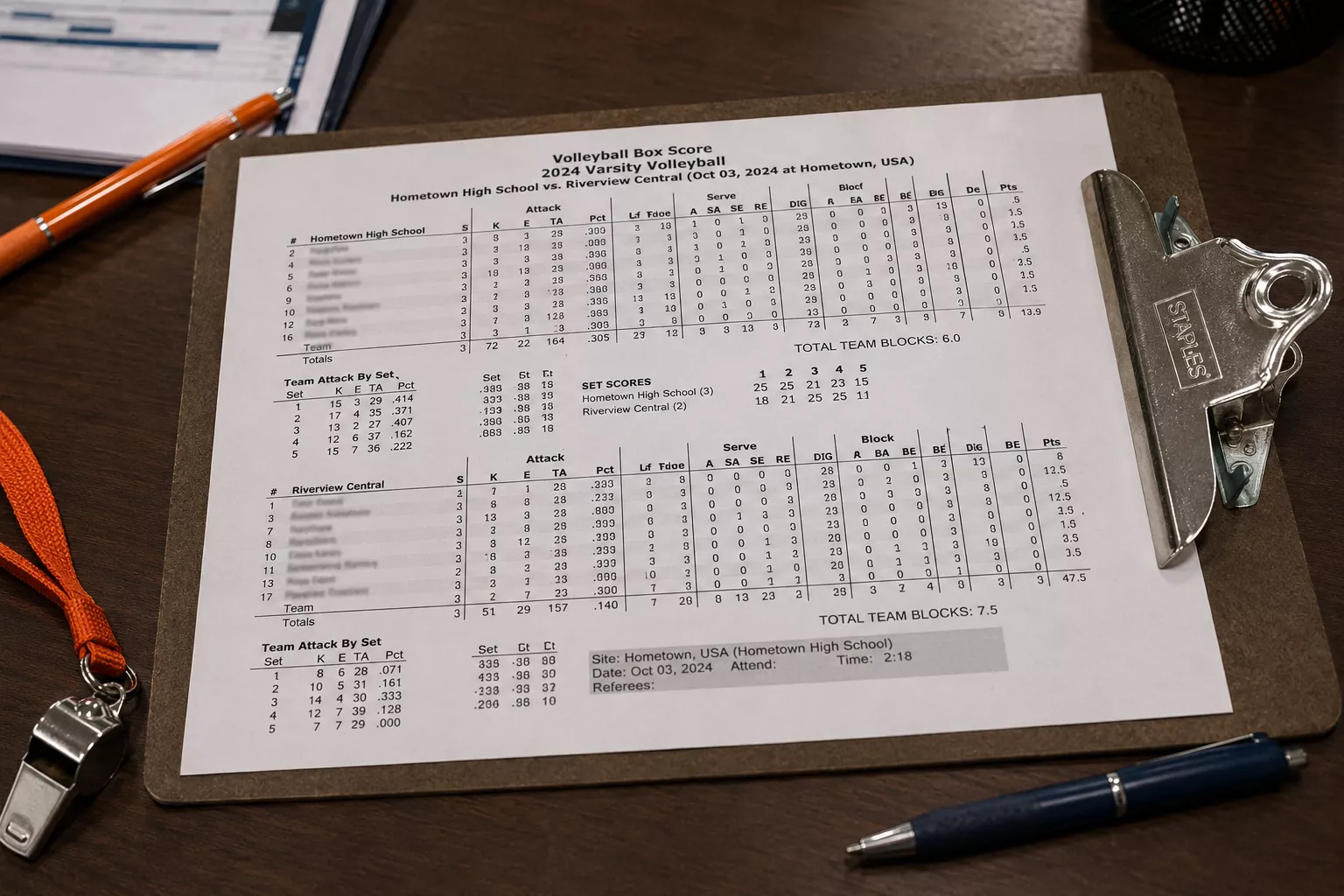

Every gym counts something. Kills, aces, blocks, digs, wins. Nobody thinks twice about it, because counting feels like the neutral part of coaching. Objective. Just the facts. But numbers aren’t neutral.
Whatever a program counts is what it teaches athletes to care about, and it teaches it without anyone saying a word out loud. A stat sheet on the wall announces a program’s values more clearly than any mission statement ever will. So the question was never whether to measure. It is what you are willing to have your athletes chase.
The trouble with the usual numbers
Kills, aces, and wins share a problem. Every one of them measures an athlete against somebody else, on one particular afternoon.
That is fine for a varsity team with fifteen roster spots and a season to win, but it is a strange thing to use to measure a 12-year-old. The tallest athlete in the gym at 12 is often done growing, yet she certainly seems dominant today. Likewise, the beginning athlete who cannot quite get the ball over the net is fourteen months from a growth spurt that changes everything. Neither of those facts shows up in a kill count, and both of them matter more than the kill count does.
There is a second problem. Quieter and worse. A number an athlete cannot move is a number she stops trying to move. So if we tell a beginner the metric is kills, we give her a number she will lose on every week for two years. Most athletes return to sports and skills in which they are successful. How successful do you think she feels if the measuring stick keeps telling her “you are not tall enough to ride this ride”?
So what should we count?
Change.
Not the athlete against the room, or the athlete against the team. Rather, the athlete against last month’s version of herself.
How many overhand serves did she make in a row today? How many freeballs did she pass to target? How many hits landed inbounds? While these seem to be simplified versions of the serving aces and kills stats, I assure you they are not. Because serving aces and kills are measuring something beyond the athlete – they are also measuring who else is on the court. But if we set the right measurements, we can measure the athlete’s journey – the journey of change.
Change is the only number in the gym that every athlete can win.
The beginner can win it. The athlete on a national club team can win it. The athlete who came back from an ankle injury and is still scared to jump can win it. Nobody is competing for a fixed number of slots, because there are no slots. There is only the question: “Am I better today than I was yesterday?“, and with the right measurement every single person in the building, no matter their age or level, can answer yes.
But wait…
Doesn’t that go soft on the athletes who are already ahead?
Good question, so here is the straight answer: of course not. Because outcome-based numbers were never what pushed them in the first place.
What pushes an advanced athlete is good coaching, real reps, and a room full of people working. A kill count does not make anyone better. It describes what already happened. Chasing it produces what chasing outcomes always produces: shortcuts. The swing she should not take. The serve she plays safe. The skill she quietly avoids practicing, because practicing it in front of people means looking bad at it for a while.
A quick note here – This is not a knock on statistics. We keep match and scrimmage stats, and they are useful. It is a knock on making them the point. A number is a good tool for planning the next session. It is a terrible thing to hand an athlete as an identity.
Why we hold this one
Delta was founded on a belief that sounds obvious right up until you try to build a program around it: everyone benefits from athletics. Every skill level, every age, every body, every athlete who is not yet sure whether she even likes this.
You cannot hold that belief and keep a scoreboard only some of them can win on. Those two things cannot live in the same gym. One of them has to go, and we would rather lose the scoreboard.
So we measure change, because change is the thing we actually value, and because athletes are universally both smart and observant. They will always work out what you value by watching what you count.
Your athlete is being measured somewhere right now. What is she learning to chase?